
Last night I devoured the new book to the best of my abilities. The time period is a little late for what I’m interested in but it does have a few things from the second century so extrapolation is fun. I read until I couldn’t read any more. Yeah. Now that’s a great evening. I learned some interesting things and must own this book so that I can devour it 4-5 times. I always learn more on every re-read. And yes, for those of you who don’t know, I read archaeological findings books. If they are about clothing. GEEK. That’s me. And a lot of my friends too.
What I have learned so far that I didn’t already know:
- Cotton sewing thread was found in Germany in the 5th century
- You can get away with things like silk fabrics and embroideries if you reproduce items from the Roman occupation of Britain but as soon as the Romans left, no more imported stuff. Suddenly silks, and perhaps cottons, disappear for several centuries. But COTTON sewing thread in Germany? Why not Britain? And I’m using silk floss so there.
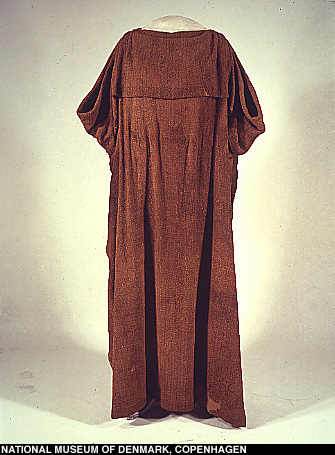
- The experts still come to some conclusions that I think are just silly. For instance on page 148 figure 5.7. They seem to think that because of this carving that women wore a peplos (see this post) but that the sleeves are not part of an undergarment but she says “Some of the Germanic women on the column of Marcus Aurelius have no gown under the peplos, but unattached sleeves running from the upper arm to cuff, as do the men?” I think she is taking a fold in the fabric to be the top end of a sleeve. I find this very interesting and am very skeptical.
- Author keeps referring to long gowns needing belts. WTF? why does the length of a gown mean it always needs a belt? Only if the gown is too long does it need a belt to hitch it up. But if you hem it shorter you are not required to use a belt. She has made this assumption based on two peplos that exist that are 1.68m long and 1.37m long. Which to me translates to 65 inches long and 53 inches long. One of the peplos’, the Huldremose peplos, shows that obviously a large portion of the length is taken up in the “bib.” What makes a belt necessary to this garment? Strange conclusion IMO.
- Linen for both under and over gowns and peplos? Quite popular, especially with the very wealthy. Which in some ways validates my questioning about linen in other ages being for the poor. This piece of information, tied to information from The Four Seasons of the House of Cerruti from the 15th century which recommends linen or a blend of linen and silk for hot weather garments leads me to think that perhaps linen for garments in between these time periods might not be all that preposterous. Especially when you match it with information from Fashion in the Age of the Black Prince which has several references to linen as an outer garment including cloaks.
- Needleworked button loops, with a foundation of a few threads back and forth covered with buttonhole stitches. A very early form of detached buttonhole stitching. For buttons and pins not decoration. YES
- Very cool diagram showing how they might create a weaving warp with a tablet woven selvedge, very clever
Obviously techniques ebbed and flowed. The Romans brought in very sophisticated techniques and materials (including for the first time, fine WHITE wool sheep) and when they left, it appears that if they didn’t take it with them it wasn’t used for some reason. That cool central heating and household running water died off for centuries. There must have been no money to build such fancy-ness after they left. I wonder it there was also a feeling of “Damn Romans, we’re not using their stuff any more. Feh.” *laugh*
I’ve mostly completed one embroidered motif on the navy wool peplos I am making. Once I get other motifs down, I will concentrate on what goes between the motifs. I have five on the front bib section and will have 5 on the back. Plus one each at the hem corners front and back (sides are slit from knee down)
The first photo below most accurately reflects the colors although the navy is a tidge lighter than this black. But the motif colors are right on. I’ve used blanket stitch (aka buttonhole stitch, only difference is the density of the stitches and the use) and stem stitch. Some folkes think that stem stitch and outline stitch are the same. They are not. In stem stitch the needle comes out of the fabric ABOVE the embroidery thread. With the outline stitch the needle comes out BELOW the embroidery thread. Completed stem stitch appears ropey. You can see the thread. Rough, textured. Outline stitch appears satiny without the threads showing clearing. Very smooth, very little texture. I like them both and use them for different effects. What many folks do is have the needle come out above or below in the same run of stitches creating neither ropey or smooth but a mixture of the two. And so it isn’t obvious the difference and that they are distinctly different if you use the rules. Above or Below. Not both.
The embroidred tryskele shows very well how ropey stem stitch is.
The motif applique is a fine red twill wool. The stuff I dyed a bit over a month ago. The threads are combination of perl cotton and a wool/silk blend. White bone disks and gold horn disks. The motif is 3″ at it’s widest points.

Showing second motif begun by tacking down to wool garment with blanket stitches

This is the back of the embroidery. You can see my fussy mitered corner hem (my modern addition). With the exception of the long stitches to attach the gold horn disks, this embroidery is almost as pretty as the front. I kind of like this too. And might do something like this on the right side between motifs or some such thing.

 Stitch Witch Cottage
I just am reading an article on early weaving vs. embroidery. One of the highlights is that translators are not consistent when translating the Greek classics and in many cases often mis-represent tapestry weaves with embroidery. The author makes the point that the woven embellishment is a one process function, while embroidery is a two-process function, and shows how embroidery came to be a thing of leisure for the upper class person. Very enlightening but I’m not sure what kind of statement it makes about how prevalent embroidery could be in an early culture.
What’s really great is that I don’t care. hahahahahaha.
Say, are you going to Ursulmas? I would love love love to meet you in person.